
We are moving through a Consider the Birds Sunday gathering series — these are the readings & “words for the journey” shared on Sunday, May 17th.
How can you just leave me standing
Alone in a world that's so cold?
—Prince, from “When Doves Cry”
I shiver and shudder in fear;
I can’t stop because this horror is just too much.
I said, “If only my arms were wings like the dove’s!
I would fly away from here and find rest—
Yes, I would venture far
and weave a nest in the wilderness.
—Psalm 55:5-7
The moment Jesus came up out of the baptismal waters, the skies opened up and he saw God’s Spirit—it looked like a dove—descending and landing on him.
—Matthew 3:16
There are lots of birds that want to avoid us, who are too wild for us, who need their space. You could call them unfriendly. Pigeons want to be close to us. They are where we are — in some of the worst places we have made (our neglected projects and abandoned buildings) and some of the best (art museums, parks, Rome’s piazzas). They won’t leave us alone.
—Debbie Blue, Consider the Birds
——
Last Tuesday night, our book club gathered on the back patio of Juice, a wine bar here in Springfield. Juice used to be Hyperion, the brewery that shared Sunday gathering space with us for two & a half years. Like all shared space, it had its challenges, but the relationships & warmth of that place also felt like home. We left because they closed, even though we had been feeling like it was time to go for a while. This was apparently the push we needed to head toward our next “home”.
The fluidity that marks our Well community is bittersweet. On the one hand, moving from place to place and being shaped by people who are with us only for a season has kept us awake, alive, and unable to say “we’ve always done it this way,” which we all know can be a recipe for stagnation.
On the other hand, it can be really hard. Adjusting to new people, spaces, and chapters can be a lot. Leaving home, as exciting as it sounds, can be exhilarating, and it can also be the source of overwhelm, anxiety, and disorientation.
It’s no wonder that times of change, transition, and loss are often depicted as wilderness — a place where it is so easy to get lost. We see this in scripture from the very beginning.
At the start of Genesis (the book of beginnings), a murky, formless wilderness of sorts exists before anything else. And it’s there in this murkiness that a Spirit hovered over the chaotic darkness.
Ancient Jewish commentary, which valued questioning, wrestling with, and expanding these texts, likened that hovering Spirit to “a dove hovering over her young”.
This will be the first of several moments where the spirit-dove meets wilderness.
Another moment involved Jesus. He had his own dove encounter at a very pivotal milestone. His cousin John had chosen to go out into the wilderness instead of staying in the temple, and there, he was teaching a radical message about a changed mind and a rearranged life. Any talk of rearranging ruffled the feathers of those on top of power - they liked things just as they were because it benefited them.
People were leaving the center of religious life to join John in the wilderness. Jesus, too, moved beyond the confines of his family, his hometown, and the only life he had known to venture into this strange, new, unsettling space. It was a wilderness teeming with life, but it was no doubt a step out of what he had always known.
As he is coming out of those wilderness waters having just been baptized by John, a spirit-dove descended on him like a holy, “hell-yes” - like a flashing neon sign with an arrow pointing down at what was happening as if to say YES, this - this right here. This is important.
Maybe we have had a few of those moments in our lives - moments where something felt as though it descended on us - an awe, an awareness of presence, a sudden shift that cannot be explained as if we were being told: yes, this — this right here — this is important.
I learned a couple of things about doves this week that blew my mind.
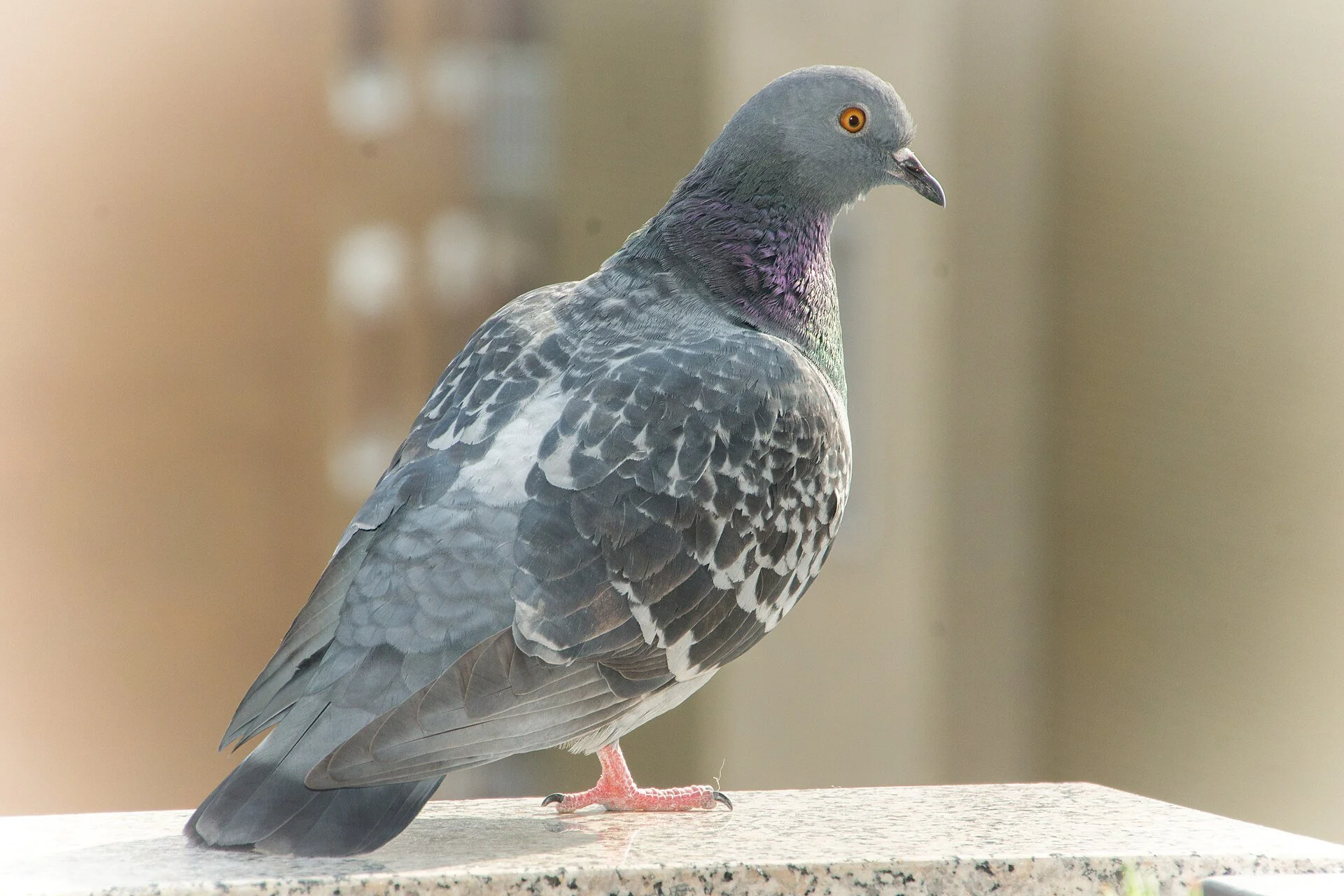
Common pigeon - Piccione selvatico occidentale (Columba livia) by Bramans via Wikimedia Commons
For starters, doves are actually pigeons by another name, explains Debbie Blue in her book, Consider the Birds. I have always thought of them as two distinct birds. Even though I see a gray mourning dove on almost every morning walk, I have mostly seen doves portrayed in culture as proper, as pure white, and as symbols of perfect peace.
But pigeons? Not so much. Pigeons tend to be depicted: in flocks, in dirty places, near people on the margins of society.
Pigeons, like the one captured to the left, have a little more spunk, clunk, and spontaneity. They are not reserved for special occasions. They are found in abundance, in our everyday places — as if to say: here, right here, everywhere is important.
The other thing I learned about doves aka pigeons is that they have an incredible skill that has been put to use since ancient times. They have the amazing ability to find their way home from hundreds of miles away. That explains why humans, from ancient Romans to the Allied forces in World War II, entrusted pigeons to carry important messages from one part of the world to another.
This ability to find one’s way home from far away could really come in handy, don’t you think?
There is, after all, so much that makes us feel adrift — we leave one grade or school to head to another, departing classmates and teachers (sometimes these are welcomed departures). We leave workplaces, communities, age brackets, roles, relationships, and seasons of life that feel like home. And sometimes we are the ones left as partners, friends or family members exit our lives.
What do we do then? How do we navigate the weird, wilderness-like realization that home is not what it just was? Can we be brought home again - to ourselves, to life now, to a space different yet also full of life?
Maybe the pigeon has a message for us today: home might serve us better as a verb than a noun. Can we learn to home?
If we continue Jesus’s journey post–dove-pigeon encounter, we will see him home — we will see him move from those wilderness waters with a deep sense of belonging. He will not just be on a boundary-breaking mission, but a boundary-making one, too. This will allow others to feel both free and at home in his presence.
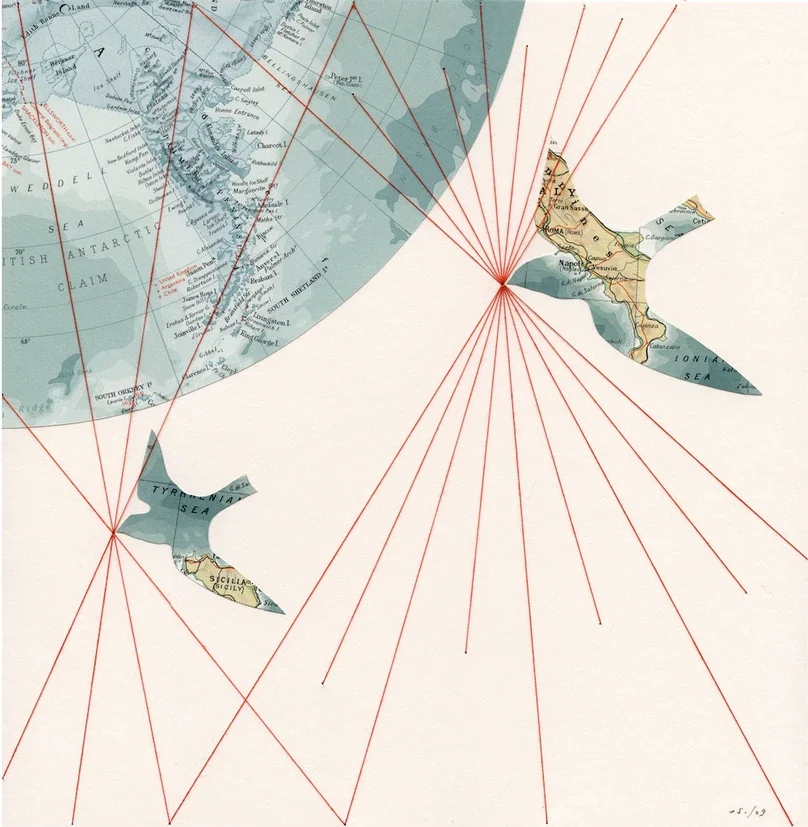
Illustration: Shannon Rankin/Selflesh.Etsy.com via Audubon.org
What if home is not this permanent place outside of us where we finally fit in, but a place inside - a place where we are learning to be at home and at peace with who we are in a way that frees us to connect with others instead of asking them to fill our need for home. That would no doubt require some serious inner work and also some practices.
What practices can bring us back to ourselves when life makes us feel unsteady?
We asked that question during our book discussion last week. One of the main characters in The Lion Women of Tehran, Homa, had her life turned upside down by an oppressive regime. She was imprisoned, yet determined that her oppressors could not — would not — steal her spirit. Still, she returned to life outside of prison disoriented and depressed. It was the practices of going for long walks, reading, and paying attention to her daughter that homed her.
Time in nature can also do the trick for some of us. So can friendship.
I have been reading Jen Hatmaker’s memoir Awake, which follows the aftermath of the life-altering discovery that her husband of 26 years had been engaged in an ongoing affair. Disorientation was an understatement. She shares about what has been re-stabilizing her. One of those things was friendship. On one occasion, she met a long-time friend for a meal - this was the first time they’d been in person after the news broke. As they ate together, Jenn spilled the whole terrible story. And when she was done, her friend Shaunal leaned back and delivered the most shocking observation:
Not “You’ll get through this” or “I hate to see you this tortured,” or “It won’t always feel this way.” Instead of any of that, she looked at Jenn discerningly and said: “I am relieved to see you are still exactly you. You sound like you. You look like you. You’re not broken.”
These words spoken by someone who knew - really knew her - proved powerful. “If she thinks I am still me, then I must really be me…I am still me, right now, right here, right in the thick of it…I guess no one can ever take me from me.”
I’m starting to wonder if we can ever really be home for each other - that’s too tall an order. Yet, we can point the way. We can cheer each other on - we can help “home” one another.
We experienced this in such a vivid way yesterday as we witnessed the Ironman right here in Jax. People lined the streets, cheering on strangers in this incredible undertaking. There were clear boundaries in place - we could not jump the blockades and run the race for these athletes - it was THEIR race to run, but we could cheer with all our might, and we did just that.
In times of turmoil, transition, and loss, the temptation might be to slink back to places we know we have outgrown or phases of life we left for a reason, or to reach for whatever shore seems the shiniest and promises to relieve the discomfort. Maybe instead, we can learn to home. Home is not a permanent place we get to - it’s something that happens to us as we are found right where we are, and something we can learn to practice alone & together.