
The kind of fullness we need right now
This is an excerpt from the “words for the journey” that were shared on Sunday, January 18, 2026 as part of our Words Made Flesh gathering series.
—
Doubt grows in emptiness.
—from A Marriage at Sea by Sophie Elmhirst
Three days later there was a wedding in the village of Cana in Galilee. Jesus’ mother was there. Jesus and his disciples were guests also. When they started running low on wine at the wedding banquet, Jesus’ mother told him, “They’re just about out of wine.” Jesus said, “Is that any of our business, Mother—yours or mine? This isn’t my time. Don’t push me.” She went ahead anyway, telling the servants, “Whatever he tells you, do it.” Six stoneware water pots were there, used by the Jews for ritual washings. Each held twenty to thirty gallons. Jesus ordered the servants, “Fill the pots with water.” And they filled them to the brim. “Now fill your pitchers and take them to the host,” Jesus said, and they did. When the host tasted the water that had become wine (he didn’t know what had just happened but the servants, of course, knew), he called out to the bridegroom, “Everybody I know begins with their finest wines and after the guests have had their fill brings in the cheap stuff. But you’ve saved the best till now!” This act in Cana of Galilee was the first sign Jesus gave, the first glimpse of his glory. And his disciples believed in him.
—John 2:1-11, MSG
And I guess one of the great agonies of life is that we are constantly trying to finish that which is unfinishable…And the thing that makes me happy is that I can hear a voice crying through the vista of time, saying: ‘It may not come today or it may not come tomorrow, but it is well that it is within thine heart. …Salvation isn’t reaching the destination of absolute morality, but it’s being in the process and on the road.
—From “Unfulfilled Dreams”, a sermon preached by Dr. Martin Luther King, Jr. one month before his assassination in 1968
—
As I’ve shared before I’ve been looking at the 1440 for most of my news for the past couple of years. They do a pretty good job of painting a more well-rounded picture of what is happening in the world, from stories covering crises to those about humankindness; however, I am still prone to feeling down when I peruse their daily email. The bad can just be really bad and feel irredeemable.
The story that brought me down on Thursday of this week was the news that we will soon officially halt visas from 75 countries, including Colombia, where our relative has a family member currently in the immigration process. As I read down the list of countries, it was so obvious that these are all black and brown-skinned nations. This, alongside the way ICE is wreaking havoc on our communities … It all feels pretty insurmountable.
How will we ever recover from this cruelty, or from the fear & scarcity mentality that is ruling over us?
Probably not the best time to be reading our book club selection featuring a shipwrecked couple whose boat sinks in the middle of the Pacific long before cell phones were a thing! Or maybe it was the perfect time. There was, after all, something unexpectedly sturdy about the human spirit revealed in the bleakness of their story - something that can almost only ever come when we are laid bare:
when we can no longer pretend, when we find ourselves in the belly of the beast or near death or not knowing how or even if we will survive - when our usual resources run out, there is room for something unexpected to rise up.
Today, I’d like to call that thing “fullness”.
Our scripture reading unfolds on a day that initially appears full of life. It’s introduced as “the third day” (aka resurrection day). It’s also the wedding day, a culmination of the joining together of two families and the creation of a new one.
Yet, all the joy those images conjure up is cut short. The wine that formed the centerpiece of the celebration has run out.
When have you known that scenario lately? When have you looked around and noticed there’s not enough - not enough time or energy or resource to meet the demands of this moment? Not enough money in your bank account to pay the bill that’s already past due? Or maybe you just feel too small and insignificant in the sea of everything we are told to care deeply about (which by the way, is a lot of things!)?
What do we do when we find ourselves in this hard place? [It feels important to name our tendencies. What are yours?]
In our story for today, what the wedding family has run out of is wine. While not the end of the world, in an honor & shame culture that prized good hospitality, this shortage would have created a shameful situation.
This moment of deficit is when we meet Mary for the first time in the Gospel of John.
Despite birthing Jesus, she has not been mentioned even once in this story so far. And even now, she is left unnamed, but Mary knows something. She has seen something in her son that is needed in this moment.
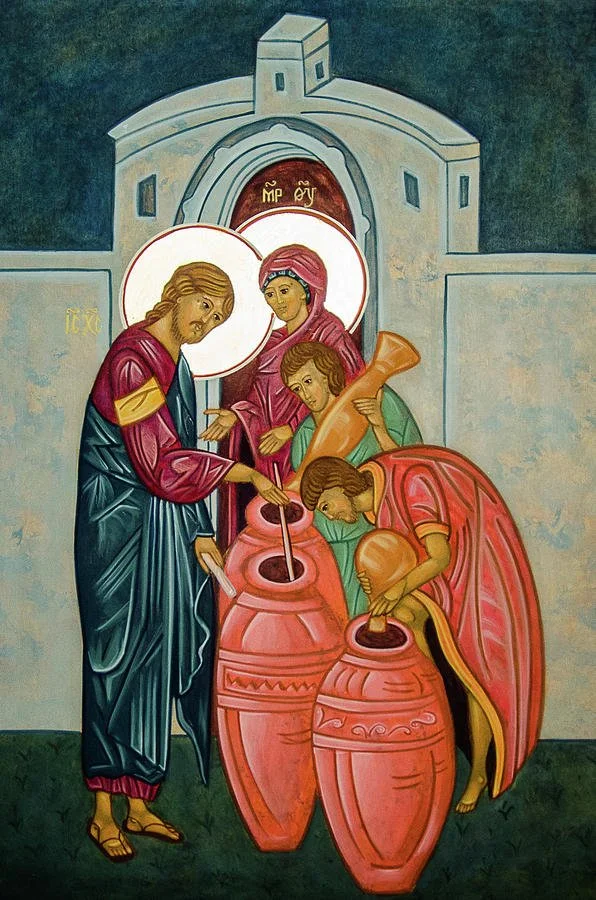
Wedding of Cana by Brenda Fox
His initial reaction to her appears to be… annoyance. Like an embarrassed teen, he brushes her off with “chill out, mom. it’s not time yet”. Mary is is not having it, though. Oh, if ever it was time, this is it, son, she seems to say, and then she tells the servers to get ready to do whatever Jesus tells them.
Even though John leaves Mary unnamed & leaves her altogether until Jesus’ execution, her role here is undeniably critical. While all the other guests seem aloof, Mary notices and draws attention to a shortage, and she names a resource that can help. She saw in Jesus a gift, a calling, and an identity that could meet this moment, and she sets something in motion.
Mary stays in the background, but her contribution is invaluable. Friends who are in supportive roles - we see you. We see your persistence, your presence, your attentiveness. You are serving an invaluable role.
Mary calls on Jesus, and Jesus, despite his initial annoyance (do note here that even Jesus got frustrated with his mother, which has to make some of us feel better!), is moved to do something. He did always seems to have trouble turning down opportunities to restore dignity and divert shame.
Perhaps he’d been something from his mother’s resolve and resourcefulness, because he looks around at what is at his disposal and sees something useful in a few empty pots.
Typically reserved for the Jewish purification rituals, these huge pots lay there empty. Jesus tells the servers to fill them to the brim, and those very specific instructions are worth noting. These Jewish pots for maintaining purity were part of a religious system that brought a lot of beauty and goodness into the world, but like all religions, was guilty of veering off track and causing harm. Ritual purification pots were not usually filled to the brim - room was left for hands to be washed before meals. Jesus is bringing life both within & beyond tradition. He will repurpose these pots - or maybe they will be brought back to their original purpose. They were always meant to be a means for bringing life - not for separating and shaming or making some superior to others.
First, there is an attentiveness and a resolve from Mary, then a creative repurposing from Jesus, and then there are those willing to follow his instructions, and somewhere in the midst of it all, something happens. There is suddenly an abundance of the finest wine - the kind that is usually served first.
What is happening here?! What is John trying to tell the ancient people first hearing this story - those who scholars tell us were feeling deflated by their circumstances, distanced from the life they had once felt connected to?
Scholars call this the first “sign” of Jesus. A sign points toward something else, and Jesus here seems to be pointing to a fullness that is found amid a deficit.
I brushed up against this kind of fullness earlier this week.
I, along with several other friends from our Well community, attended a book conversation at the Episcopal Cathedral downtown. The featured author, Nico Lang, is a queer journalist who had reached out to The Well directly to invite our community to the conversation about his book, American Teenager: How Trans Kids Are Surviving Hate and Finding Joy in a Turbulent Era. As I listened to the conversation, it was clear his book is a response to a shortage of voices advocating for trans youth in a time when they are being met with cruelty, suspicion, and a plethora of targeted legislation meant to diminish their humanity.
Nico already had access to many of their stories; he also had authenticity and an ability to earn trust. He had his own queer identity, and he knew this was something he could contribute to this moment, so he wrote a book featuring the stories of American trans teenagers - the stories of Wyatt, Rhydian, Mykah, Ruby, Clint, Augie, Jack, and Kylie.
Afterward, I waited to meet Niko and to get a signed copy of his book. I applauded his work and commended his plans to keep sharing about it indefinitely. That’s when he stopped writing, looked up at me, and said plainly “oh honey, what else am I going to do?”
What I saw in him was not bitter resolve, but an abundance - a fullness of life where it was being hollowed out.
Jesus was a sign pointing to this kind of fullness - not so much a destination but a kind of life that rises up to meet the moment -
whether in unexpected creativity,
in a nudge toward deep presence and connection,
in a resource that suddenly becomes visible,
in parents and grandparents, and teachers who see gifts in their children that they were not able to see in themselves,
in our seeing and naming gifts in each other that we fan into flame,
in daring to be who WE are in this moment.
Fullness is not perfection nor is it completeness - it’s life that is relentlessly flowing to meet the moment. That’s what I saw in Niko, that’s what I saw in Dr. Martin Luther King Jr. He was imperfect, and he said so himself, and yet, he was also constantly pointing to that fullness of life that belonged to everyone.
This is the kind of fullness we need right now.
—
God who goes by many names, who is like a river of life that keeps flowing and inviting us to swim with the current for the sake of our own souls and for the sake of our neighbors’ wellbeing, we thank you for continuing to invite us into this fullness. Help us to see and to move with You this week.